

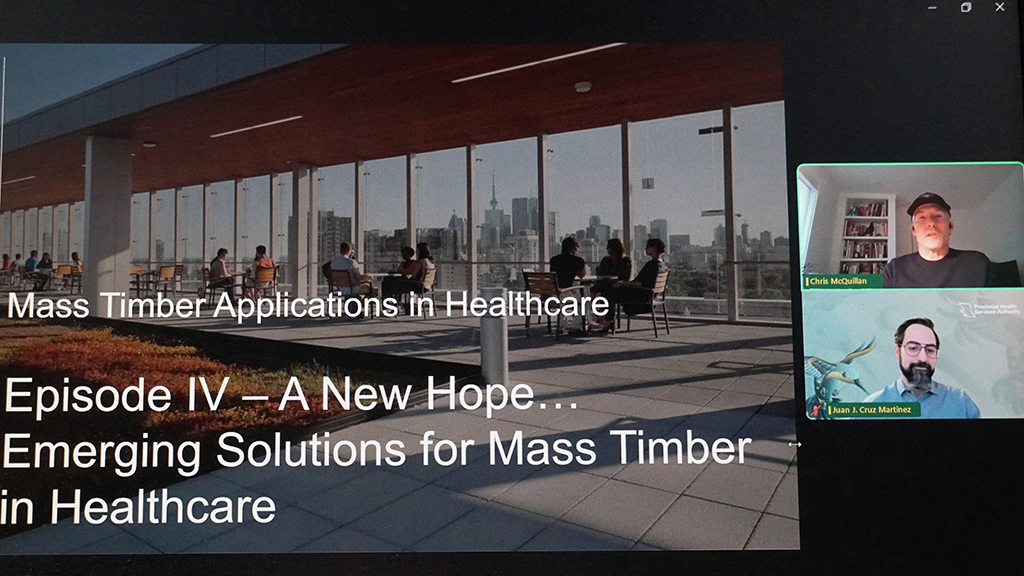
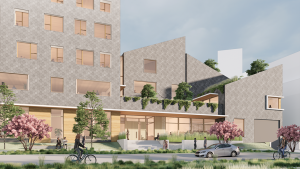
A study on the use of mass timber in the construction of a 200-plus bed acute hospital will help health care clients and others understand the benefits of integrating the timber medium without compromising performance, safety, regulatory compliance or adding significant cost.
Christopher McQuillan, principal of KPMB Architects, who led the study in collaboration with B.C.’s Provincial Health Service Authority, told a webinar audience mass timber would add 4.1 to 4.5 per cent more than concrete/steel in construction costs, but that number represents a small portion of the life-cycle costs of the operation of a hospital.
“We should be looking at design for health care that optimizes operations as well as life cycle because the initial capital cost is relatively small,� McQuillan told a WoodWorks webinar titled Emerging Solutions for Mass Timber in Healthcare.
He added KPMB is looking at where cost reductions over the lifespan of the building can be made.
McQuillan and his team chose a horizontal or flat mass timber design for a test case hospital in part to align with the structural, fire safety and operational needs.
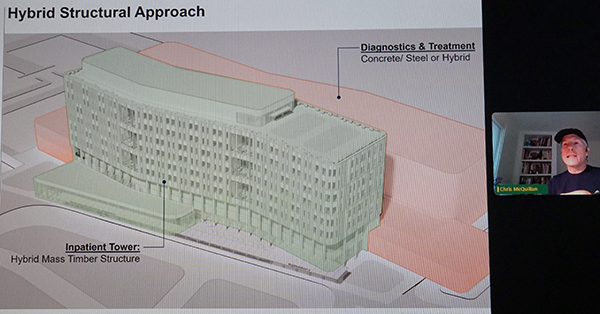
While the typical space configuration for a large hospital does not usually align with mass timber dimensions, McQuillan’s team was able to modify a grid to 7.5-by-4.6-metres for the bedroom with bathroom modules to provide the flexibility and space required for plumbing and detailing.
The mass timber hybrid structure employs Delta beams on laminated (glulam) wood columns with CLT decks spanning between the beams. Perimeter timber beams are part of the lateral system for windloads. The cores and primary lateral system are concrete.
He said it is likely the diagnostics and treatment departments would remain as a concrete or hybrid concrete/steel structure, partly because of the demanding span requirements.
To secure a building permit the mass timber project would follow an alternative solutions design process based on research, sound engineering practices and fire testing, said Lisa Miller-Way of CHM Fire Consultants Ltd, a consultant to the study.
She told the webinar audience to meet the “robust� baseline code requirements for fire in the in-patient areas with mass timber there is “substantially more fire compartmentation in terms of zones and fire separation for patients� than in other-use spaces in the hospital.
The project would also increase sprinkler density in mass timber areas.
Stair shafts and elevators would be pressurized to manage vertical smoke movement and other pressurized zones would further mitigate smoke migration. Sleeping zones would have multiple evacuation points, she said.
McQuillan said mass timber reduces the weight of the structure by 33 per cent over concrete and steel. It also results in a 64 per cent reduction in embodied carbon.
To meet infectious control standards, the timber medium will largely be used in “low touch� areas. Non-porous coatings (clear varnishes and epoxies) ensure hygienic standards are met.
“Using wood in health care, particularly until there is more science, is going to be a balance between a risk benefit strategy and the placement of the wood which will be subject to a lot of control,� he said.
Juan Jose Cruz Martinez, a senior director of capital projects for B.C.’s Provincial Health Services Authority, told the webinar that PHSA believes mass timber offers opportunities “to create resilient, efficient and healing centre buildings,� while providing a pathway to meet environmental and operational goals.


Recent Comments
comments for this post are closed