

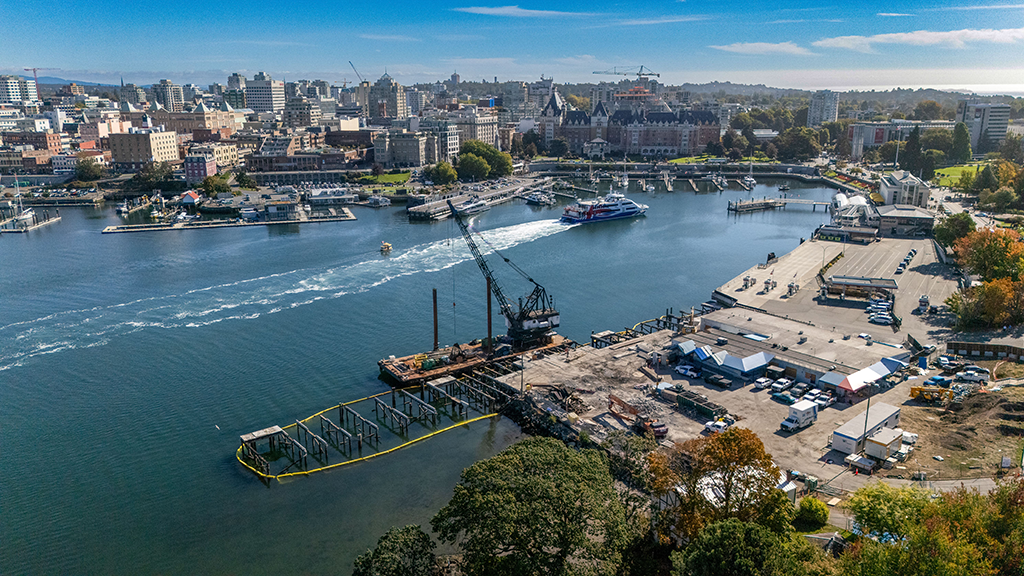
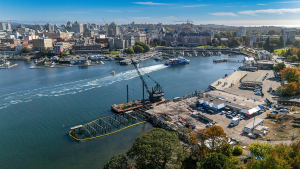
°µÍř˝űÇřion crews are digging deeper into the heart of Victoria, B.C.’s Inner Harbour as the $416-million Project enters a critical new chapter.
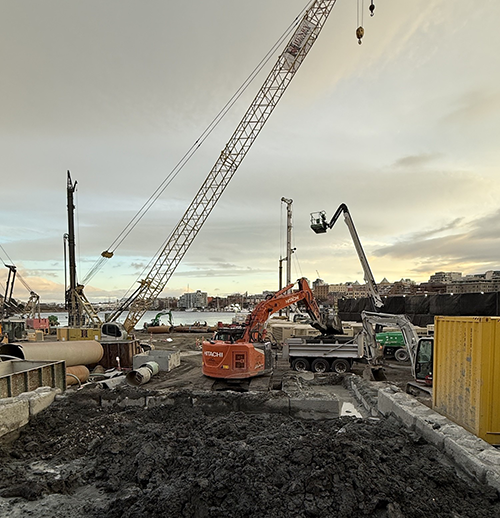
A tower crane, roughly 58 metres tall with a boom that has a working radius of 80 metres, is now up and running at the site, lifting materials, equipment and structural components into place.
Foundation piles are being installed for a new terminal building and wharf. Fencing panels have been erected that recognize the traditional territories of local Indigenous people.
Demolition of the old Clipper terminal infrastructure is now complete, and the massive project has shifted into heavy construction mode.
The work, now focused on foundations, marine infrastructure and construction of a new pre-clearance terminal, will reshape one of British Columbia’s most important transportation gateways.
“°µÍř˝űÇřion at the Belleville Terminal redevelopment project continues to progress as planned and remains on track for completion in 2028,” the B.C. Ministry of Transportation and Transit said in a statement prepared for the Journal of Commerce.
The redevelopment is transforming the provincially owned, privately operated international marine terminal into a modernized port of entry serving ferry links between Vancouver Island and Washington State, while improving trade, border security and the passenger experience.
The first phase of the project, completed in February 2025, was designed to keep ferry operations running while enabling redevelopment to proceed.
That work included modifications and expansion of the Steamship Wharf so the Clipper vessel could continue service, construction of a temporary tensile terminal structure, a covered pedestrian walkway linking the Steamship and Black Ball buildings, and renovations inside both heritage structures to accommodate U.S. Customs and Canadian Border Services operations.
Sequencing in the first phase allowed demolition and permanent reconstruction to proceed without shutting down the international gateway.
The second phase of the project, awarded to Pomerleau Inc. under a design-build contract, was launched in June 2025 and represents the largest and most complex portion of the venture. It includes replacing aging wharf infrastructure, constructing a new pre-clearance terminal and commercial goods processing facility, adding retail space and improving surrounding public realm features such as sidewalks and walkways along Belleville Street.
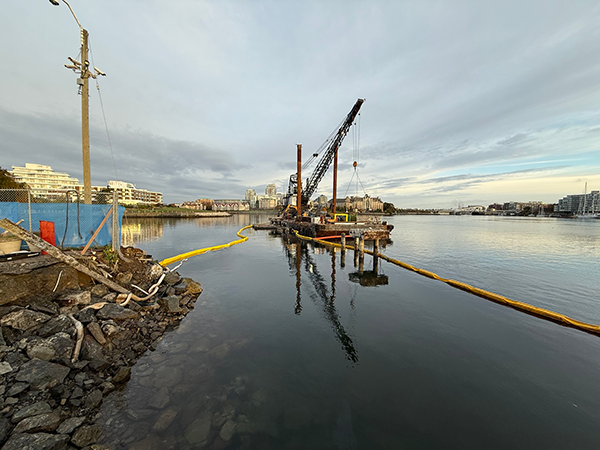
A major focus right now is the extensive piling program, with more than 320 foundation and marine piles being installed through 2027.
Next up this spring and summer is more foundational work, completion of final dredging and additional site offices to support a growing workforce.
Building the foundation of the new terminal will involve concrete work, installing service conduits for future utility connections and waterproofing.
“Piling activity is progressing well and will be ongoing through 2027,” the ministry stated. “The activity involves deep foundation piles for the new terminal building and marine piles to support the future wharf structure, with continuous monitoring of noise and vibration levels.”
Mitigation remains a major component. Continuous vibration and noise monitoring is in place, perimeter sound barriers have been installed and regular equipment maintenance is aimed at minimizing disruptions to nearby residents, businesses and tourists.
More than 100 marine piles are already being installed at Stores Wharf, while deep foundation piles for the terminal itself are advancing. Building the terminal foundation will involve significant concrete work, utility service conduits and waterproofing systems – the literal groundwork for the project’s centrepiece.
Though the visible work today centres on the new build, phase two began with extensive demolition and site preparation. Crews removed the former Clipper wharf, previous Clipper terminal and former U.S. Customs and Border Protection building.
Major utility disconnections were completed, site access widened and the safety fencing was erected around the perimeter. The fencing panels share the cultural and historical information about the Songhees and Esquimalt Nations.
Cultural and archeological monitors from local First Nations have also been onsite during construction activities.
When complete, the new terminal will be defined not just by border processing upgrades, but by ambitious sustainability and accessibility targets.
The pre-clearance facility is being designed to meet modern border security standards and support commercial goods processing, but it will also incorporate commercial retail units and achieve high-performance environmental and accessibility benchmarks.
Among the standout features are a targeted Rick Hansen Foundation Accessibility Gold Certification and LEED Gold certification, along with compliance with CleanBC and the province’s Environmental Stewardship Policy standards.
Those features are intended to make the terminal both inclusive and resilient while reducing greenhouse gas emissions and improving long-term operating performance.
The project’s price tag has climbed from an earlier estimate of $331 million due in part to complex geotechnical and seismic conditions, contaminated soils and challenging waterfront site constraints.
In 2019 alone, Belleville Terminal handled more than 680,000 travellers, supported roughly 2,200 jobs and generated substantial tourism spending. Provincial figures show passenger activity contributed $268 million in economic output and $155 million to GDP.
Government projections suggest the redeveloped terminal could support even greater impacts in future decades, while strengthening trade and travel ties in the Cascadia corridor.




Recent Comments
comments for this post are closed