

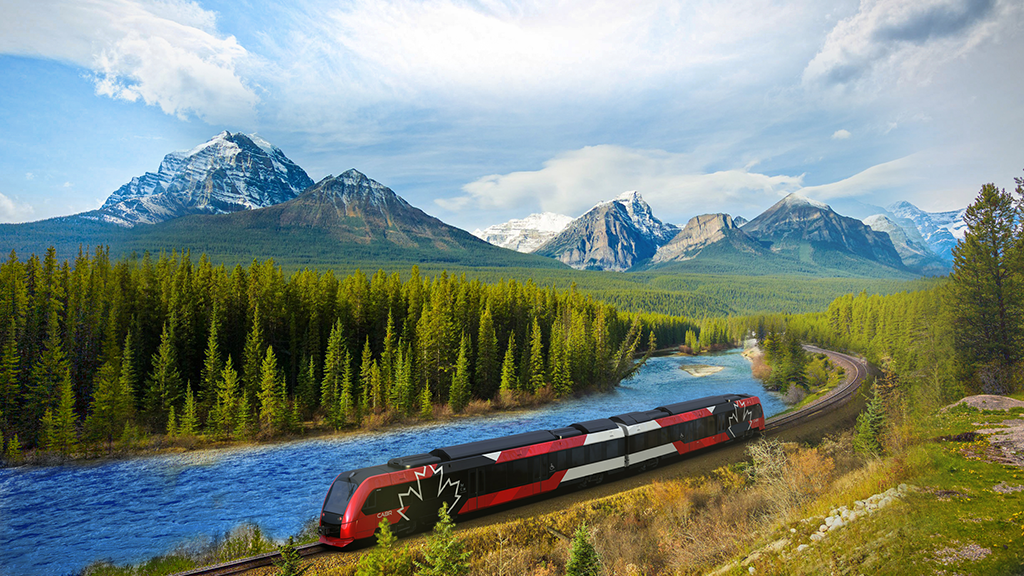
The proponents of a well-developed plan to bring new passenger rail service directly from the Calgary airport to the city’s downtown and west to Banff are welcoming an endorsement from Canada’s Building Trades Unions (CBTU), expressing hope the backing creates momentum for a project stalled by what they consider to be provincial policy inertia.
The Calgary Airport–Banff Rail (CABR) project was launched in 2019 with a proposal from Liricon Capital to the Canada Infrastructure Bank (CIB).
Liricon, Plenary Americas and the CIB say the section from downtown Calgary to Banff along the existing Canadian Pacific freight corridor is shovel-ready, and once detailed design is completed the new westbound track could be built within three years.
But all plans are on hold awaiting the release of a long-delayed provincial Passenger Rail Master Plan.
Bruce Graham, executive director of Friends of CABR, a project advocacy non-profit, said the province could get two projects for the price of one if it formally commits to building rail from the airport to downtown Calgary within the master plan, complementing the CABR’s proposed downtown-to-Banff section.
“Let’s get on with this,� said Graham in an interview.
“There’s a lot of work that’s been done. We’re just waiting on the province to identify what their priorities are and move forward. We’re encouraging them to accelerate that, because everybody wants to see infrastructure built and not just studied.â€�
Attempts to reach the Alberta Ministry of Transportation and Economic Corridors were unsuccessful. One recent published report indicated a ministry official said the master plan would be released later this year.
Hydrogen powered
The CIB was attracted in part by the proposal to power the high-frequency train using hydrogen fuel cells. The support has led to stakeholder engagement with all levels, market analysis, project structuring and pledges of low-cost financing.
The CABR project has been submitted to the federal Major Projects Office and the proponents have urged the province to do the same for the Calgary-airport-to-downtown leg.
Technical appraisal of the rail technology has included multiple meetings and site visits with major hydrogen rolling stock providers including Alstom, Siemens and Sumitomo.
The vision and scope of the CABR has evolved over time from its initial $1.5-billion submission to the province under its unsolicited proposal framework.
Now, with the province likely assuming responsibility for the 20-kilometre Calgary airport to downtown project, the CABR proponents have altered their proposal for the remaining 130 kilometres of track to ensure a seamless 150-kilometre trip door to door.
“We’ve suggested to the province that if they give us three trains an hour on the airport to downtown line, just using their line, we’ll continue service all the way to Banff at no cost to the province…perhaps with open bidding and procurement,â€� Graham said.
He explained the proposed cost has escalated over the past six years but the developers have “deep pockets� and can afford the risk.
The proponents envisage significant development opportunities at station stops including Calgary West, Cochrane, Stoney Nakoda Nations, Canmore and Banff. As an owner of a long-term lease for the Banff station and surrounding 32 acres of land, as well as the adjacent Mt. Norquay report, Liricon will spearhead development at the western terminus.
Brownfield savings
Once a decision is announced by the government on preferred new rail projects across the province including, it is expected, the Calgary airport to downtown route, Graham says the timetable for the CABR project would advance in earnest, quickly and cheaply, given it’s a brownfield project.
Obtaining permits, securing a provider and undertaking detailed design is targeted to take 18 months to two years, and construction would last two-plus years, covering three construction seasons, Graham said.
“It’s not a decades project, it’s a project that’s built in years,â€� he said.
Last month it was announced the CBTU, the Building Trades of Alberta and the Friends of CABR had signed a Memorandum of Understanding to formalize support for the project.
“Passenger rail from the airport through downtown Calgary to Banff is more than transportation, it’s an economic development strategy,� said Liricon chair Adam Waterous in a statement.
CBTU executive director Sean Strickland cited numerous reasons his association got involved at this stage, prior to discussions of precise labour needs. The project would take cars off the road all along the corridor and in Banff National Park, support sustainable technology, create almost 10,000 job-years and generate nearly $700 million in economic output over a three-year build, he said.
“We think it’s a really good project to get behind,â€� he added.
“Most transit projects, not just unique to Alberta, but across Canada, it’s hard to get momentum, and it’s hard to get these projects across the finish line. So we’re happy to team up with Adam Waterous…and with (Friends of CABR).â€�

Recent Comments
comments for this post are closed