

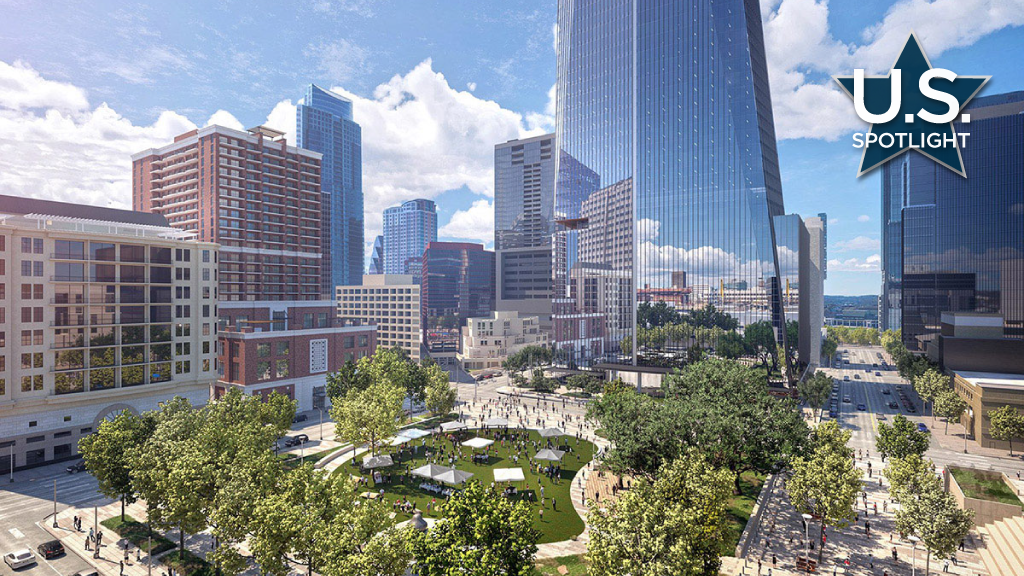
What a difference a year makes. Last October, the City of Austin was preparing for the construction of new commercial developments that promised to transform and upgrade areas within the city’s downtown. Although these projects remain “on the books,� many await word as to when construction is likely to start.
Nikelle Meade, partner in real estate development and construction industry sector of law firm Husch Blackwell LLP, feels broad market conditions are causing uncertainty. She cites tariffs, increased materials costs and high interest rates as unfavorable to construction.
“I just feel like right now there’s a lot of change, and nobody knows (when it will end),â€� Meade told . “The crystal balls are a lot cloudier.â€�Â
It’s not only interest rates and tariffs that are slowing progress. Local resistance to some new developments has also been strong.
For example, commencement of work on the 3.5-million-square-foot multi-tower project called received city council approval in December 2022 but had been delayed by a lawsuit from the Texas environmental non-profit group . Only this past June did the courts finally rule in favor of the development.
Reports also suggest Austin’s overall economy isn’t what it used to be.
to only 0.7 per cent in the Austin-Round Rock area from August 2024 to August 2025. This reflects a year-over-year population increase of only 4,000 to July 2024, according to the U.S. Census Bureau, marking the slowest pace of growth of all major Texas cities. High-tech hiring is down as well. Venture capital firm Signalfire Austin suffered a six per cent drop in headcount at VC-backed start-ups.Â
Although Colliers Austin’s overall commercial office vacancy has dropped from an earlier peak, with many workers returning to the office, it remains at around 23 per cent. In tandem, new office supply shrank considerably from over 500,000 square feet to only 112,000 square feet. Rents dropped alongside.
Regionally-specific vacancies across Austin are high as well. The Colliers report says office vacancies in the city’s desirable central business district are over 27 per cent, with a 37 per cent vacancy rate in northeast Austin.
This has furthered the hesitation of developers to build new office space. to CBRE, Class A and B office space under development in Austin dropped to below two million square feet in Q1 2025, a mere one-third of what it was in Q2 2002.
One bright spot in the commercial office space sector was the opening earlier this month of The Republic, a 48-storey, 800,987-square-foot tower in the central business district. Approximately half of the building’s space has been leased.
The Republic hopes to counter Austin’s office slowdown by offering tenant amenities such as 23,000 square feet of indoor space and 25,000 square feet of landscaped outdoor space on the 19th floor. This includes a fitness center offering locker rooms with private showers and changing areas, a breakfast and coffee lounge, a bar and a sharable boardroom.
The question being asked is, “What comes next?�
Two mixed office and residential towers, the 74-storey Waterline and the 58-storey , are both expected to be open within the next 12 months. A 66-storey residential-retail tower proposed by San Antonio-based developer Kairoi Residential may rise off West Sixth Street, but no start date has been announced. Houston-based Hines has signed a ground lease with the Texas General Land Office to redevelop the two-acre site of the defunct William P. Hobby Jr. State Office Building, although it’s unclear what might be built.
Little else appears to be on Austin’s horizon. This has some observers feeling pessimistic.
“I can’t imagine another office building, a major office building, starting here before 2030,� Mark Miller, senior vice-president at Lincoln Property Co, told .
It’s much the same on the outskirts of Austin. Suburban areas offering more affordable housing than the downtown core are experiencing a slowdown, with annual home starts down 15 per cent year-over-year and s down 13.2 per cent since August 2022.
Beyond data centers, many commercial developments outside the core also remain only on paper. For example, a 390-acre mixed-use project in Bastrop, southeast of Austin, promising a hospital, a hotel and convention center, entertainment venues and shops is still in the preliminary stages.
Developer Kazem Khonshari told the project is expected to be presented to city council soon, but would likely need the approval of a and to help pay for infrastructure upgrades on the project. A masterplan developer has not yet stepped forward, although individual businesses have expressed some interest in the venue.
“We have sharks. The water is being chummed,” said city manager Sylvia Carrillo-Trevino. That comment accurately summarizes the future development outlook for Austin.



Recent Comments
comments for this post are closed