

SAN FRANCISCO — Two recent installations by San Francisco Bay Area art and design studio FUTUREFORMS aim to reframe how digital craft, public space and large‑scale sculpture can come together in contemporary cities.
Orbital, a 34‑foot‑tall permanent public art sculpture at the entrance plaza of the OpenAI Headquarters in Mission Bay, San Francisco (originally commissioned for the Uber Headquarters), and Weatherscape, a 70-foot-by-40-foot sculptural canopy at the new El Paso Children’s Museum (“La Nube�), demonstrate how advanced computational design and fabrication can deliver both iconic landmarks and richly experiential public environments.
Founded in 2009 by Jason Kelly Johnson and Nataly Gattegno, the studio’s work is grounded in what it calls Digital Craft — a practice that leverages algorithmic design and custom fabrication protocols to generate complex forms and finely tuned material performance.
Orbital: a “creature off the garden�
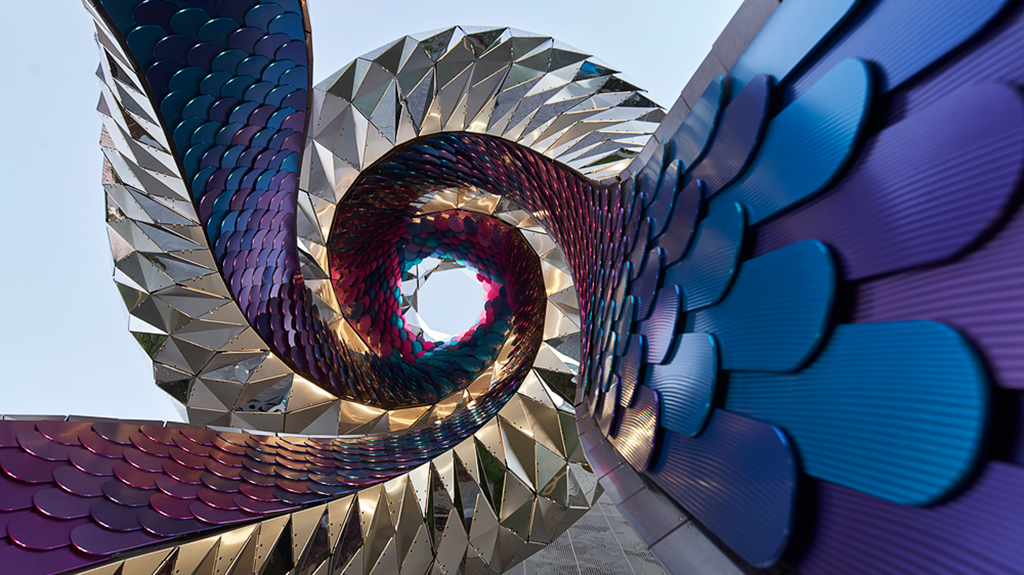
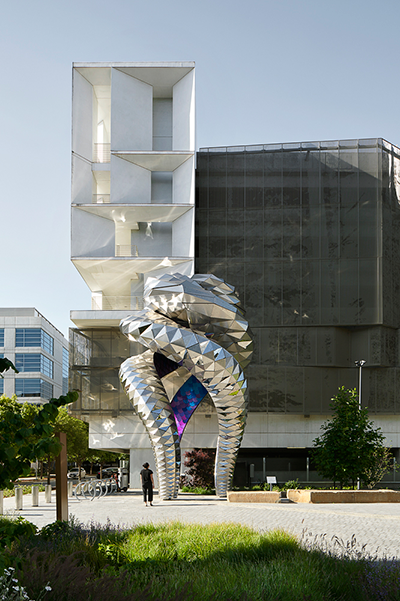
Standing 34-feet-tall in the entrance plaza of the OpenAI campus in Mission Bay, Orbital is conceived as a contemporary garden folly—a hybrid of architectural object, sculptural form and social space.
Commissioned as a visual anchor for the former Uber Headquarters, the piece was designed not simply to occupy the forecourt but to “fundamentally activate the public sphere.�
1/4
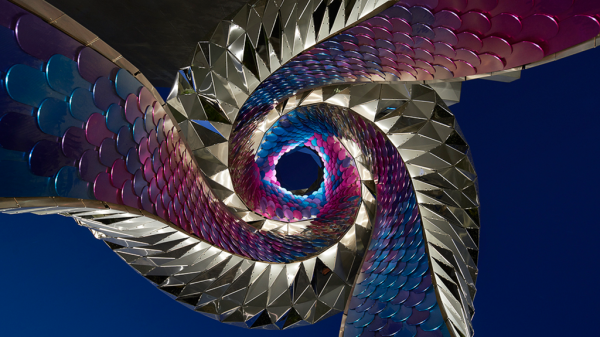
MATTHEW MILLMAN — Orbital is a 34-foot-tall permanent public art sculpture by FUTUREFORMS. The studio was commissioned for the entrance plaza of the Uber Headquarters, now occupied by OpenAI, in Mission Bay, San Francisco. The work acts as both an iconic visual anchor and an intimate space for public interaction. Involved in this project: FUTUREFORMS, lead artists and design and fabrication; Shop Architects, architecture; Surface Design, landscape design; and Arup, structural engineer.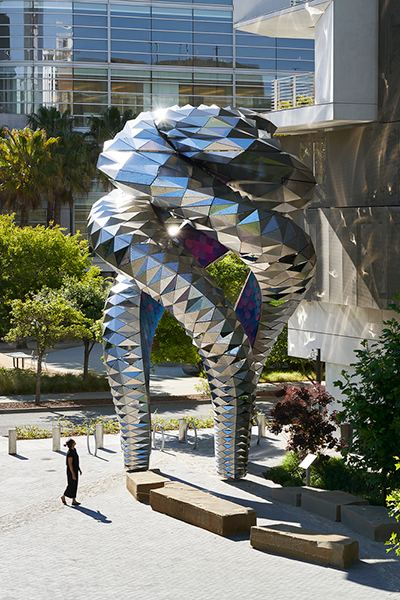
2/4
MATTHEW MILLMAN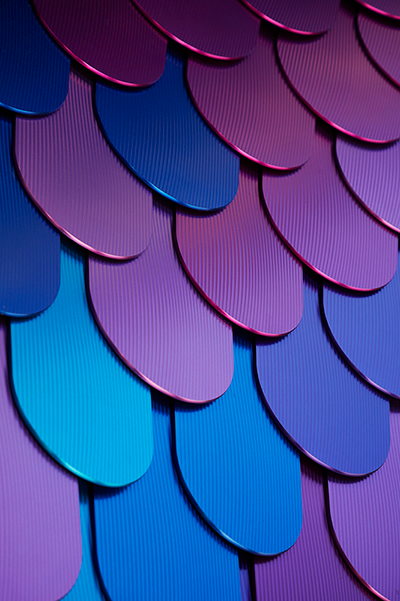
3/4
4/4
MATTHEW MILLMAN
Its dynamic, coiled form appears to rise directly from the plaza, an effect Johnson and Gattegno describe as a “Creature off the Garden�: a figure that feels at once organic and otherworldly, bridging the digital and the botanical.
Orbital’s twisting mass suggests natural systems — vines, tendrils or muscular roots — while also calling up the awe‑inspiring scale of a giant robot or futuristic space vehicle. That tension is amplified by its construction: the tower is built from thousands of custom stainless steel and aluminum elements, its structure wrapped in a skin of highly reflective, tessellated, marine‑grade stainless steel. Its exterior is perforated by a constellation of fine openings, scattering light and reflections across the surface and interior, creating an intimate, immersive experience at ground level even as the sculpture reads as a bold, highly legible landmark from a distance.
Weatherscape: a living laboratory of weather
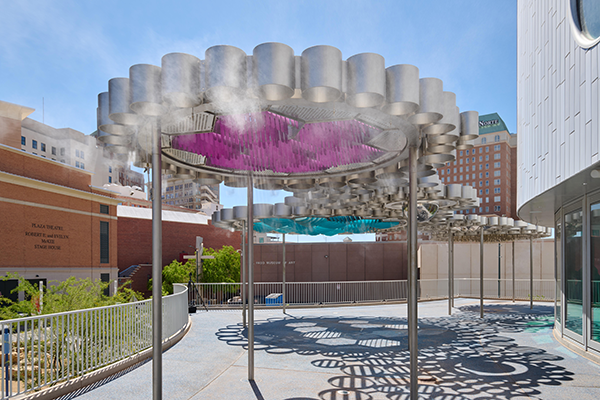
Where Orbital rises vertically from an urban plaza, Weatherscape stretches horizontally above the second‑floor terrace of El Paso’s new La Nube establishing a powerful visual identity for the institution and a shaded, experiential environment for visitors.
1/4
GENARO LIMON AND BRIAN WANCHO — Weatherscape is a 70-foot-by-40-foot sculptural canopy that acts as a landmark for the new El Paso Children’s Museum. Positioned on the second-floor terrace, Weatherscape is more than a shade structure, it is an immersive environment, acting as a "living laboratory of wonder" that channels the site’s weather conditions into optical, material and sound effects. Involved in this project: FUTUREFORMS, lead artists and design and fabrication; Snohetta, architecture and landscape; and Endres Studio, structural engineer.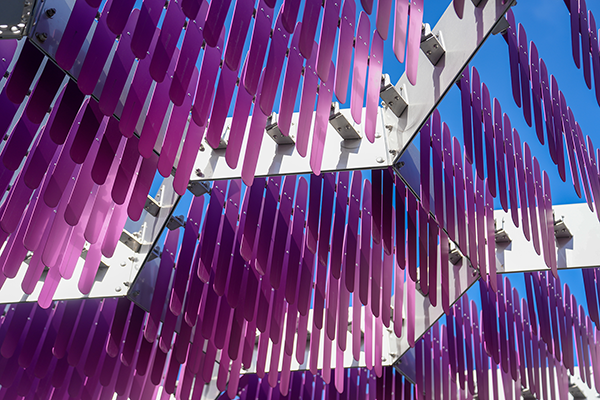
2/4
GENARO LIMON AND BRIAN WANCHO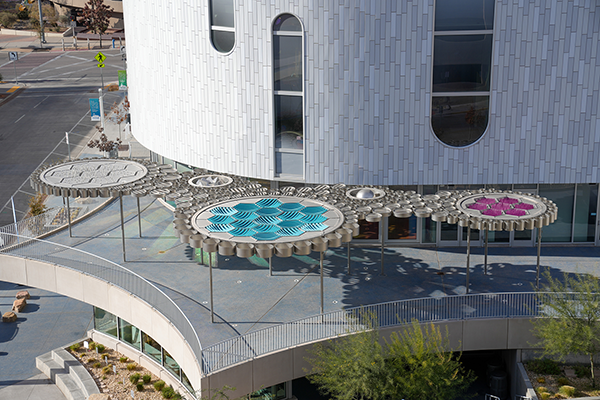
3/4
GENARO LIMON AND BRIAN WANCHO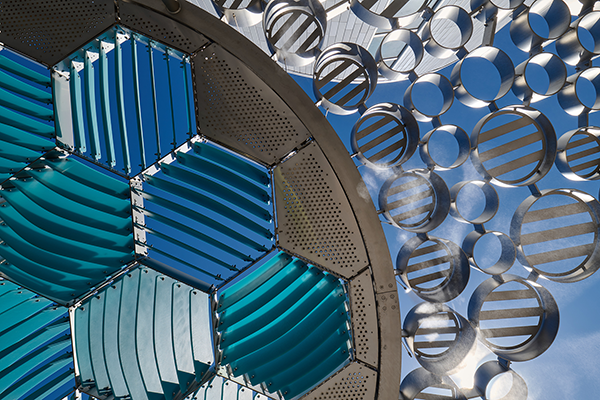
4/4
GENARO LIMON AND BRIAN WANCHO
Measuring roughly 70-feet-by-40-feet, its canopy deliberately blurs the line between infrastructure and artwork. FUTUREFORMS describes Weatherscape as a “living laboratory of wonder�: an environment in which sun, wind and water are not obstacles to be mitigated, but forces to be choreographed. The canopy’s sweeping, outward‑reaching geometry evokes the organic spread of algae, forming a field of overlapping elements that catch, filter and redirect environmental conditions. Among its key technical and design strategies is active weather interaction such as dedicated circular zones within the canopy focus specific phenomena — wind, water and sun — into experiential pockets. Visitors move through shifting patches of shade, sparkle, sound and spray, gaining a tactile understanding of the region’s intense climate.
Built for the desert conditions of the U.S.–Mexico border, Weatherscape is engineered around durability and resilience. The canopy is fabricated from stainless steel, acrylic and aluminum, materials selected for their resistance to corrosion, UV exposure and extreme heat.
Digital craft driving urban public art
Across both projects, FUTUREFORMS’ Digital Craft methodology is central. Algorithmic design tools and custom fabrication protocols enabled the studio to manage thousands of bespoke components, tune perforation patterns and structural behaviour, and choreograph how light and weather move through and around each installation.
The result is a new model for public art in the context of high‑profile civic and institutional projects; works that are simultaneously landmarks, laboratories and lived‑in spaces. At Mission Bay, Orbital offers a reflective, sculptural counterpoint to a tech campus; in El Paso, Weatherscape transforms a museum terrace into a climatic playground.
Together, the two projects show how digitally driven design and fabrication, when married to a deep reading of site and climate, can produce public artworks that are not just seen, but felt — and that evolve with the environments they inhabit.

Recent Comments
comments for this post are closed