

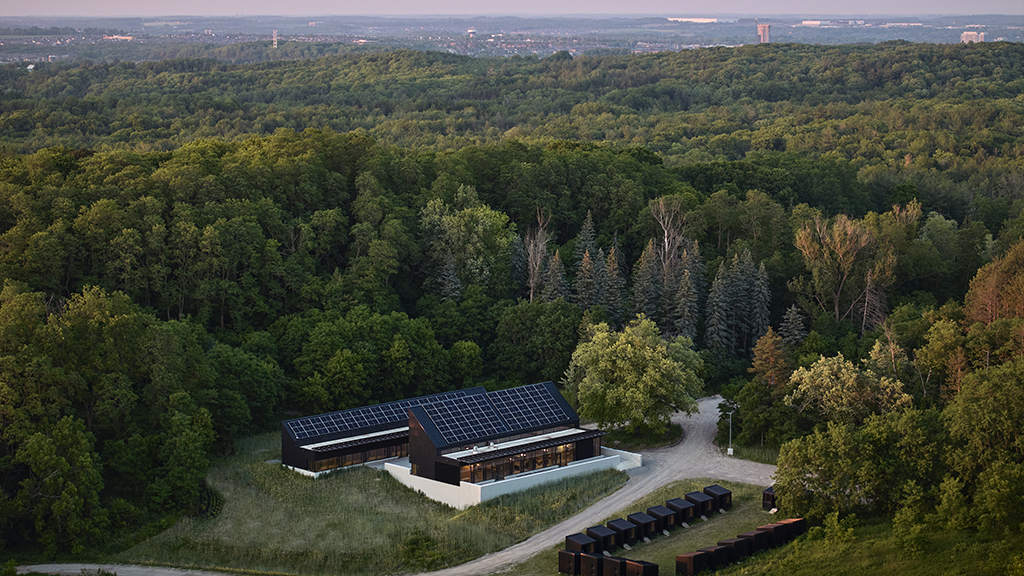
The University of Toronto’s Koffler Scientific Reserve’s (KSR) new operations and educational centre stands as a striking presence that is in harmony with its agrarian surroundings in the Oak Ridges Moraine.
For the design team of Montgomery Sisam Architects “there was no prescient, inspirational moment” guiding the form for the building to be home for research and instruction in ecology and environmental biology, says Karine Quigley, the project’s architect for MSA.
Instead, the building’s appearance is closely linked to how it functions.
While net-zero energy and net-zero carbon targets are among the goals of the building, Quigley says the unusual project provided an opportunity to incorporate a number of passive design elements, which don’t have a place in the energy standards.
“We were trying to have a building that essentially could have the systems off for as long as possible (shoulder season),” she says, pointing out the building is oriented on the property to maximize the solar effect in winter.
The roof is equipped with photovoltaic panels, expected to produce and store 100 per cent of the building’s annual electricity tab.
A rooftop weather station works in tandem with an advanced automation system to regulate interior temperatures, which includes adjusting windows when needed, the architect points out, adding the building’s orientation determined the size and location of windows.
“We did studies on how high the windows needed to be to get daylight to all the spaces, allowing us to reduce artificial lighting.”
To retain solar heat in winter, the architect specified concrete flooring for its thermal mass (heat storage) properties.
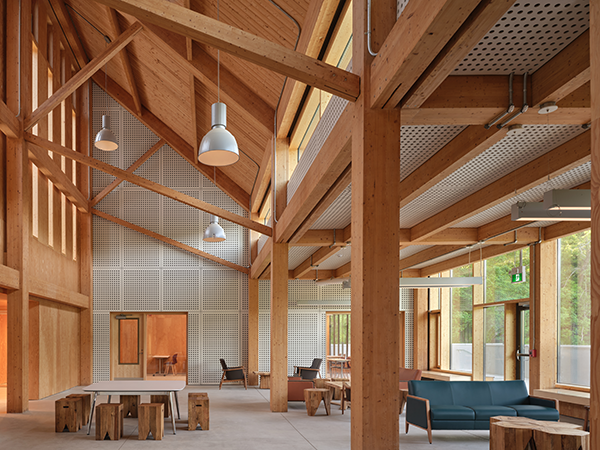
For air circulation, the tall main hall draws air in at a low level on one side of the building and out through tall slip windows. White perforated fibre-cement panels address the interior’s acoustic needs and remain stable through moisture and temperature swings as the building opens and closes to meet its passive design goal, Quigley says.
To minimize the project’s carbon footprint, roughly half of the building’s structure is comprised of glulam columns and beams supporting a tongue-and-groove deck. The remainder, including the dormitory, is built of lightwood framing, says Quigley.
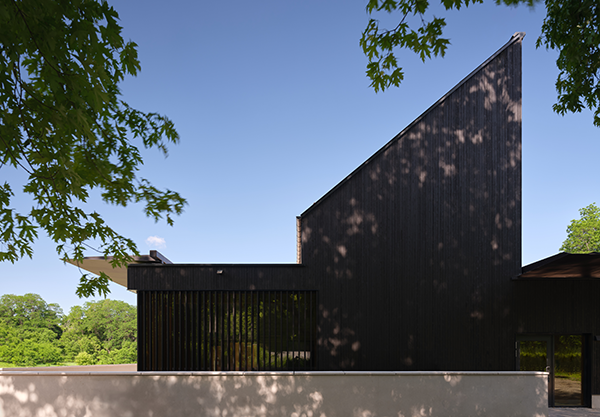
Features include a glulam curtainwall and charred cedar cladding, a traditional Japanese method of protecting wood from insect infestations, moisture intrusion and fire.
MSA specified plywood to cover interior walls, rather than drywall, for its durability and simplicity.
It gives the interior “a rougher, less manicured” feel, Quigley says. “We didn’t want to make the building super-precious.”
Heating and cooling are provided by a ground source system, supplemented by an “earth tube” that channels fresh air through a below‑grade conduit around the building, tempering the air before it reaches the plant.
The project had to meet a number of approvals through regulatory entities including the conservation authority.
“We had to fit the building only on areas that were disturbed by previous buildings,” she says.
The additional period it took to work out a strategy with the team of consultants gave the architect time to work on the design – “a luxury” in the architectural world, Quigley says.
The consultants included Blackwell Structural Engineers and the Integral Group, now called Introba, which was the mechanical/electrical and sustainability consultant. Van Horne °µÍø½ûÇøion Ltd. was the GC.
Quigley says Van Horne and its subtrades faced challenges out of the norm for a building only the size of some estate homes (900 square metres) in the area because “it has all the complexity of a larger sustainable project.”
Quigley says projects like Koffler can be difficult to design when all the stakeholders are not on the same page.
“This project wasn’t because everyone was excited and there was so much expertise in sustainability, timber construction. It felt to me like we finally got to use that knowledge and implement it.”
Quigley says energy data will be monitored and evaluated in a year or two to see if the building is performing up to its net-zero goals.
“When you get a chance to use all these strategies, you want to make sure that they are working as designed.”
Recent Comments
comments for this post are closed