

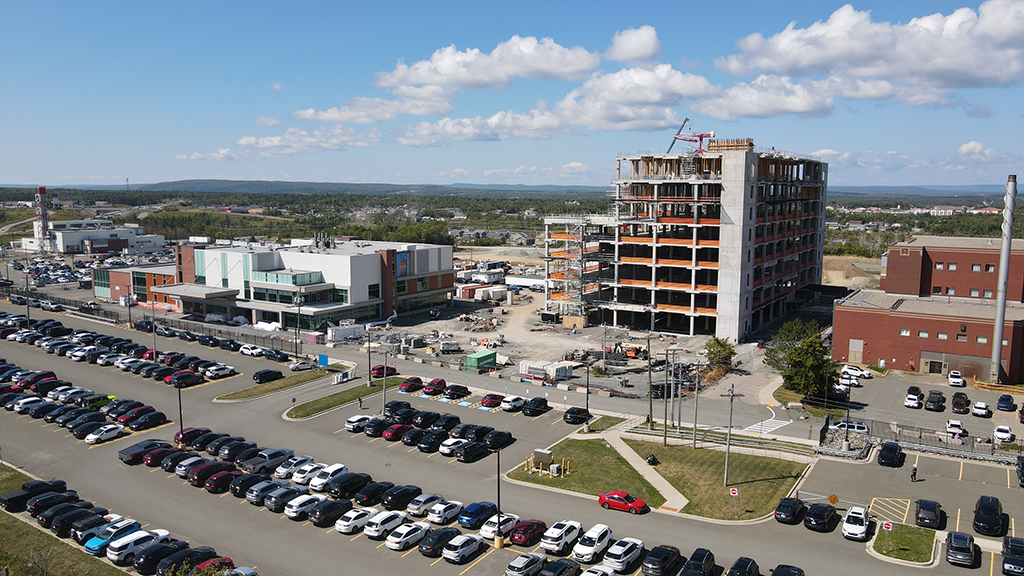
Cape Breton’s major hospital expansion is about to enter its “peak� construction phase as the campus adds a massive western side to its current 1990s footprint.
The so far $270 million tendered project’s centrepiece is an eight-storey clinical services building, along with a two-storey new cancer centre and an innovative biomass energy plant, the first building to be completed.
The build will add 450,000-square-feet of bricks and mortar to the existing 580,000-square-foot hospital. The project is also part of a major revamp of health services for the region, estimated at more than $1 billion.
“We are trying to realign the way we deliver health care in Industrial Cape Breton,� Troy Penney, clinical director for health care redevelopment for the Cape Beron Regional Municipality, said. Instead of several smaller hospitals this will “bring some of the more acute services to Sydney and create hubs or health centres� in New Waterford and North Sydney.
°µÍø½ûÇøion began in 2023 on land owned by the hospital on the southern rim of Sydney beside a six-lane ring road and adjacent to the Membertou Mi’kmaq First Nation, which will have two roads connecting to the site.
The three buildings will complete an L-shape with a parking lot in the middle and serve as the hospital’s new front door.
Clinical services will have expanded ER and critical care as well as eight new surgical suites and 72 private inpatient beds. It will also house maternal and newborn services. Meanwhile, the cancer centre will see a vast expansion over present services designed to treat less than half the number now using it. Coming on stream in 2027 it will also offer “holistic� space for gardening and traditional Mi’kmaw smudging ceremonies.
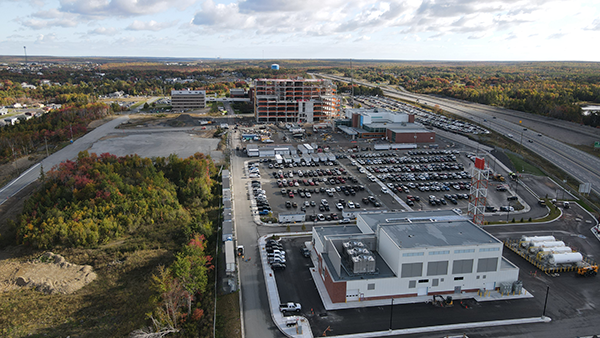
The existing hospital will be “extensively renovated� where the former services were provided, Penney said.
“When we move our maternal program out to the new building that will be renovated to help offset the medical students we have onsite.�
And the new eight storey building will become the “acute side� while the existing one will offer outpatient and convalescent care.
Clinical services will be finished in 2031. Overall completion and renovation is to be finished by the mid-2030s.
The project is the biggest public investment in Cape Breton. It saw the largest continuous concrete pour – about half a day for the cancer centre’s radiation bunkers – in the island’s history.
The revamped campus (new and old) will now be heated and cooled by the energy centre’s biomass plant, to be finished in six months. It will burn 40 per cent oil and 60 per cent wood chips, sourced from Cape Breton.
“It would have been material left on the forest floor,� Roy MacDonald, project manager for Build Nova Scotia, the provincial Crown agency overseeing construction, said. “It’s not like we’re cutting down merchantable timber to create fuel; we’re using essentially what would be waste material form forestry operations.�
The plant is also in the forefront of what the province hopes will be a model going forward, “so kind of a trendsetter I guess,� Penney added.
There are four kilometres of telethermic (hydronic) pipes servicing the campus and a European-built boiler.
“It’s a reasonably complicated installation,� MacDonald said.
The piping is normal insulated steel pipe, but the kilometres comprise a redundant system, “so two completely separate systems that both do the same thing, just to have health care redundancy.�
It wasn’t a problem sourcing material to this relatively isolated part of northeastern Nova Scotia – “no different from any project in the country,â€� MacDonald said.
On the trades front, union discussions began in 2018 and “we’ve faired pretty well� with 90 per cent (of 150 workers) from Cape Breton itself.
A hospital project incurs more complexity than other builds because it’s more than meets the eye.
The civil aspect – earthwork, concrete, piping – “are pretty much normal (but) at the point that we are in now these projects really turn into mechanical and electrical installations,� MacDonald said.
Things like cabling, cable tray, sewer pipe and conduit are complex.
What makes a hospital work “are hidden behind the walls and above the ceilings� or “a million Lego pieces.�
This “will always drive how quickly you can put (the build) together.�
The project is being developed through a construction management model.
“It isn’t a traditional design-bid-build where you design it and then go to market,� MacDonald said, instead, it “allows us to get in the ground sooner and design components as the project develops.�


Recent Comments
comments for this post are closed