

Ìý
Post-Pandemic Rebound and Spending Trends
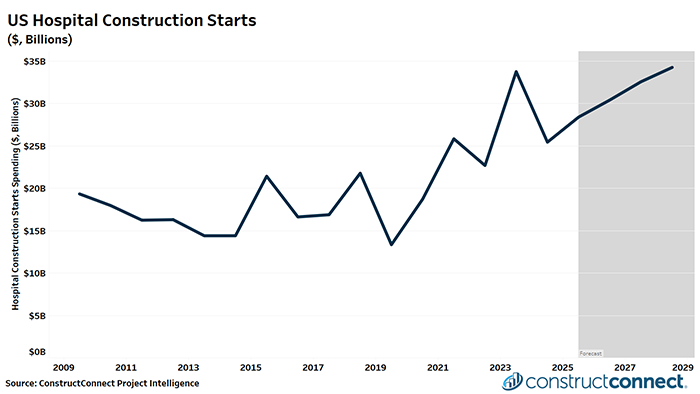
After a period of fluctuation, theÌýÌýis demonstrating renewed vigor. According toÌý, spending on hospital starts saw a significant dip in 2020 to $13.4 billion amidst global uncertainty.
The following years showed a steady but uneven recovery, culminating in a powerful surge to $33.8 billion in 2024. While 2025 has moderated to a strong $25.5 billion, theÌýpoints toward a sustained cycle of investment.
This rebound comes as health systems move past the “pauseâ€� of the early 2020s, restarting deferred projects and launching new initiatives. Capital constraints andÌýÌýdrove the initial decline from 2020 to 2023.
Now, with greater clarity, organizations are deploying capital to address aging infrastructure and meet evolving patient needs.
Ìý
Renovation and Modernization Take Center Stage
While new, ground-up hospital towers capture headlines, a significant portion of capital is flowing into the renovation and upgrading of existing facilities.
Many health systems are prioritizing theÌýof aging campuses to improve building systems such asÌý, bring facilities up to current codes, and enhance the patient experience.
This emphasis on infrastructure is crucial for operational resilience and efficiency. A recent industry survey highlighted that over 60% of health systems expected toupgrades. This trend signifies a broad effort to ensure that legacy facilities can support modern medical technology and delivery models.
For contractors and architects, this translates to a steady pipeline of complex renovation and systems-integration projects.
A Strategic Shift to Outpatient and Satellite Facilities
The traditional, centralized hospital campus is no longer the sole focus of healthcare construction. A significant trend reshaping the industry is the strategic pivot toward a distributed network of care.
Health systems are aggressivelyÌýÌýwith ambulatory surgery centers, medical office buildings (MOBs), cancer treatment centers, and freestanding emergency departments.
This “site of careâ€� shift brings services closer to where patients live and work. It also reflects a financial strategy, asÌýÌýare a growing source of revenue for providers. This move toward smaller, more numerous projects spread across metropolitan and suburban areas creates diverse opportunities forÌýfirms.
While large-scaleÌýcontinue, much of the growth is happening in these satellite facilities designed for convenience and specialized care.
Hospital Design and Delivery Innovation
The way hospitals are designed and built is also evolving. To meet tight schedules and control costs, many projects are leveraging innovativeÌýmethods.
Prefabrication andÌýÌýare becoming more common, with some large-scale projects reporting significant time savings by using prefabricated components for everything from patient rooms to complex mechanical systems.
At the same time, design is becoming more human-centric. Recognizing the impact of the physical environment on healing and staff well-being, architects are incorporating trauma-informed and biophilic design principles.
This includes maximizing natural light, providing views of nature, and using warmer, more welcomingÌý. Furthermore, significant investment is being made in staff-centric spaces—such as respite rooms and collaboration areas—to help reduce burnout and improve retention.
Outlook: A Strong Forecast for Hospital °µÍø½ûÇøion
Looking ahead, the future for hospital construction appears exceptionally bright. The combination of an aging population, the need to replace outdated facilities, and the competitive drive to capture market share will continue to fuel capital spending.
a robust growth pattern for the remainder of the decade.
- 2026 Forecast:ÌýHospital construction starts are projected to climb to $28.4 billion.
- 2027 Forecast:ÌýThe upward trend continues, with spending expected to reach $30.4 billion.
- 2028 Forecast:ÌýGrowth accelerates further, with starts forecasted at $32.6 billion.
- 2029 Forecast:ÌýThe decade is expected to close on a high note, with starts projected to hit $34.3 billion.
This sustained, multi-year expansion underscores a fundamental strengthening of theÌý. For general contractors, architects, engineers, and building product manufacturers, this outlook signals a period of significant and lasting opportunity. The demand for specialized, efficient, and human-centered healthcare facilities is set to define the construction landscape for years to come.






Recent Comments
comments for this post are closed