

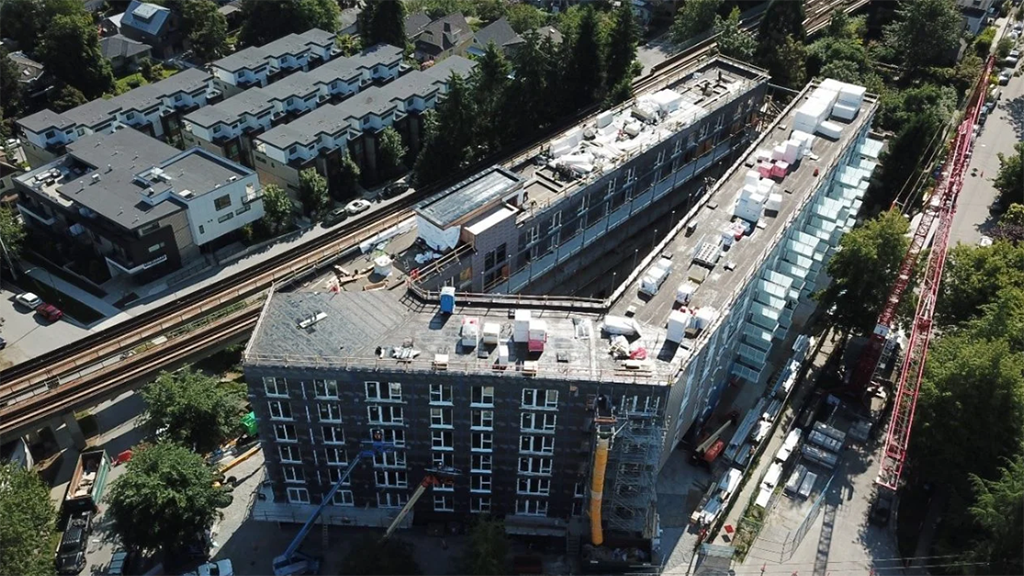
Kindred °µÍø½ûÇøion Ltd. and Sapphire Balconies (Canada) Inc. are partnering to install 40 unique outdoor balconies at a new residential development on the east side of Vancouver.
Vienna House is a six-storey affordable development of 123 rental apartments arranged around an interior courtyard. Final completion is expected in spring 2026.
The owners of Vienna House are BC Housing, the City of Vancouver and the More Than a Roof Housing Society.
Vienna House contains materials and processes that deliver high-energy performance with low greenhouse gas emissions.
And the mechanical design ensures ready access to fresh air and minimizes noise from the nearby SkyTrain rapid transit line and the vehicle traffic on Victoria Drive.
However, the project faced the challenge of achieving energy efficiency if it ordered and installed traditional concrete balconies.
To add balconies in most concrete residential buildings, builders cantilever an apartment’s floor slab outward past the exterior walls and then add railings.
Balconies done that way invite a phenomenon called thermal bridging, which draws heat from inside the apartment to the outdoors, which increases energy use.
In most cases in B.C., the energy in question is natural gas that is burned in boilers, which produces greenhouse gases.
In contrast, the Sapphire balconies that are installed at Vienna House are “thermally broken.�
Because they are attached to the building with hooks, slide-on brackets and suspension rods, the balconies transfer very little heat to the outdoors.
Sapphire says its prefabricated balconies are ideal for Canadian projects.
They are compatible with reinforced concrete frames, cross-laminated timber frames, light gauge steel frames, tunnel form systems and Peikko DELTABEAM systems.
In addition, factory-built balconies provide long-term value in the form of fewer site errors, improved construction quality and lower maintenance costs.
Because the balconies are made of aluminum, they are significantly lighter than concrete.
This allows for greater design flexibility, easier transportation and installation, and a reduced load on the building.
An ideal-for-Vancouver feature is that rain flows through the balconies’ decking to a catchment area underneath.
Each balcony unit is tested to meet Canadian building standards, with resistance to wind uplift, structural deflection and thermal bridging designed into every module.Â
Sean Binns, the project director of Kindred, the Vienna House general contractor, says it’s the first time the Sapphire balconies have been used in Western Canada.
“They’re clipped straight into place,� says Binns. “Sapphire’s module is one component compared to 10. It’s much easier and less complex than traditional concrete balcony installation, which can be time-consuming and frustrating.�
Although installation is easy, it requires detailed engineering in advance.
“After that, productivity increases quickly because you’re repeating the same installation process over and over again,� says Binns.
Antonio Manchisi, Sapphire’s vice-president of construction, says the balcony modules are manufactured in 11 factories around the world “in a wide and extensive supply chain.�
“The balconies installed at Vienna House were manufactured in Sri Lanka,� says Manchisi. “They were taken to Vancouver by ship and then trucked to the construction site for final assembly.
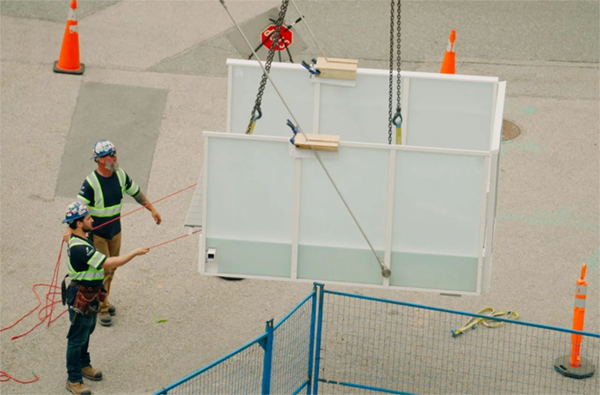
“A Kindred crane lifted the balcony modules into position, and workers guided them onto pre-installed hooks and brackets on the sides of the building.�
It takes one worker two to three hours to install the two brackets. A second worker then attaches the stabilizer bars when hoisting the balcony. The installation of the balcony on the brackets takes less than half an hour.
Manchisi says Sapphire has approximately 30 projects worldwide on the go now, including seven in Canada and one in the U.S.
One of the Canadian projects is the North Shore Neighbourhood House in North Vancouver, which will use approximately 70 Sapphire balconies.
“We see more modular construction taking place in Canada in the future, including Sapphire balconies,� says Manchisi. “It will be partly as a result of the investment by the Canadian federal government in Build Canada Homes.�
The Build Canada Homes (BCH) initiative is a federal government program whose intention is to use modular and prefabricated construction to build housing faster and cheaper.
According to the government, the program will streamline regulations and provide financing to developers.
The initiative includes an initial $13 billion to build 4,000 modular homes in six cities – Edmonton, Winnipeg, Toronto, Ottawa, Longueuil, Que. and Dartmouth, N.S.
The goal of BCH is to scale up to 45,000 homes in the future.

Recent Comments
comments for this post are closed