

°µÍø½ûÇøion stakeholders say the Mark Carney government’s first budget highlights the essential role major project spending will play in transforming the Canadian economy during a time of threats and uncertainty – and the indispensable contribution constructors will play in creating a new capital-rich economic future.
The Association of Consulting Engineering Companies – Canada (ACEC) suggested in its budget analysis that with the introduction of a new capital budgeting framework, the government “signals that it intends to prioritize major capital projects, housing, clean energy infrastructure and workforce development.â€�
“It’s a whole new ballgame,â€� said Canada’s Building Trades Unions executive director Sean Strickland, “doubling down on infrastructure and on investment tax credits to stimulate investment in construction projects across the country.
“If you dig a little deeper into the budget, you’ll find a lot of very encouraging nuggets and nuances in there for the construction industry in general, and for the unionized construction industry specifically. So we’re quite pleased with the tone and tenor and direction of the budget.â€�
Amid the generally positive response to the budget from most stakeholders, the Canadian Home Builders’ Association through its CEO Kevin Lee expressed disappointment in what Lee said was a lack of support for private-sector homebuilding.
“We’re definitely concerned,� said Lee. “There not enough in there to recognize the housing crisis going on right now, particularly as it pertains to housing for home ownership.�
Federal funding for the new Build Canada Homes agency was welcome but supports mainly social housing, Lee said. Given the target to double housing starts, he said, the government needs to extend GST relief to all buyers; it should act on its election commitment to reduce development charges; and it needs to address the stress test.
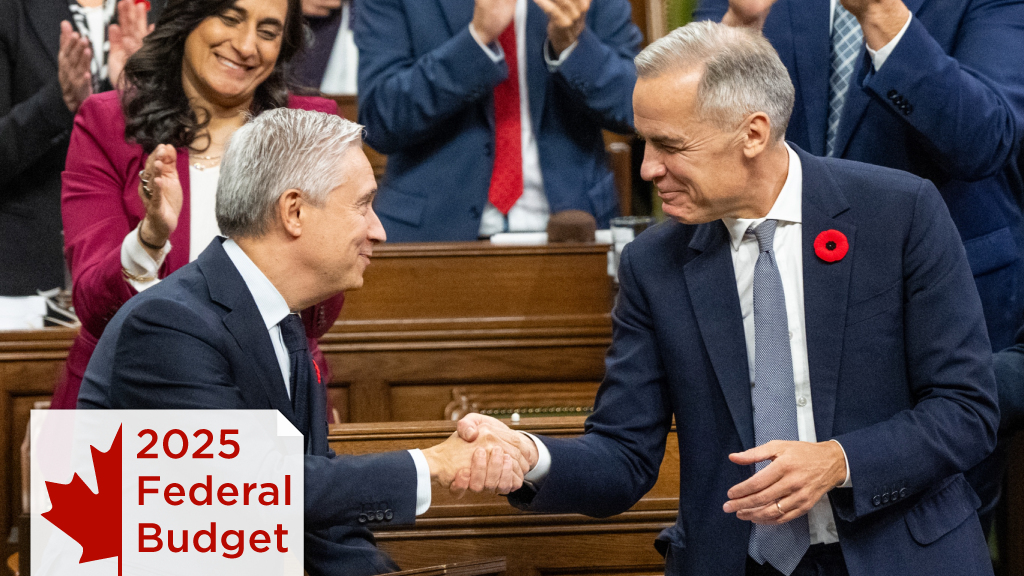
Labelled Building Canada Strong, the spending framework unveiled by Minister of Finance Francois-Philippe Champagne Nov. 4 featured $141 billion in new spending and a $78.3-billion deficit. Four anchors of spending over the next five years include housing, with a $25-billion allocation; $115 billion in infrastructure spending; $30 billion for defence and security including billions for defence infrastructure; and $110 billion on productivity and competitiveness.
Crowded-in investment
Carney said the following day there was a potential for the combination of public spending and crowded-in private investments to reach over $1 trillion in total infrastructure, housing and other expenditures by 2030.
The ACEC bulletin said the pledged $115 billion in infrastructure spending through such funds as the Build Communities Strong Fund, Trade Diversification Corridors Fund and Arctic Infrastructure Fund “translates into a potential pipeline of projects across multiple sectors.�
ACEC CEO John Gamble stated, “The Build Communities Strong Fund will help address Canada’s infrastructure deficit while empowering local governments to deliver the housing, transportation and health facilities Canadians urgently need.�
Mechanical Contractors Association of Canada COO Ken Lancastle said the budget introduced only broad brushstrokes of policies such as a new Workforce Alliance plan and the $13-billion “productivity super-deduction,� noting his association was prepared to get to work fleshing out the multiple new initiatives.
“There’s opportunities for companies in Canada to invest and improve productivity, to help make these infrastructure investments happen efficiently and productively,â€� said Lancastle.
“Talking about the major projects, talking about the clean energy infrastructure or investment tax credits to see these projects realized, is going to require the mobilization of major trade contractors like the mechanical contracting sector to make those things happen.�
Expensive to build
University of Toronto infrastructure professor Matti Siemiatycki suggested it was “hugely important� for the construction sector to take advantage of a half-dozen budget measures to boost productivity and competitiveness.
“There’s a huge need for infrastructure in a country that’s hugely expensive to build in,â€� he said, citing elevated costs to build transit and housing.
“I think it’s going to take incentives and then it’s going to take direct engagement on the projects that are publicly led, to drive doing things differently than we’ve always done.â€�
As for the extent to which infrastructure spending will stimulate the economy, Siemiatycki commented, “I think it’s a wait and see…the specifics are going to be what determines whether this succeeds in being transformational or kind of continues more of the same.â€�
Strickland noted the Carney government indicated in the budget it would continue to favour traditional trade unions for federal project delivery – a pledge both the Canadian °µÍø½ûÇøion Association (CCA) and the Progressive Contractors Association of Canada (PCA) took issue with.
“Union training programs play an important role in building Canada’s workforce, but we must ensure equitable access to training and credential recognition for all workers, including the 70 per cent of Canada’s construction workforce that is non-unionized,� said CCA president Rodrigue Gilbert in a statement. “If we want to build more homes and infrastructure faster, we need investments that don’t leave the majority of workers behind.�
Gilbert said the CCA welcomes spending on housing-enabling infrastructure to address the housing shortage as well as the launch of the Major Projects Office. He said the CCA continues to call for a co-ordinated national workforce strategy “that connects immigration, apprenticeships, upskilling, and the destigmatization of careers in the skilled trades.�
A PCA statement praised the infrastructure pledges but cautioned the government must ensure Canada’s project approval process becomes more efficient and predictable.







Recent Comments
comments for this post are closed