

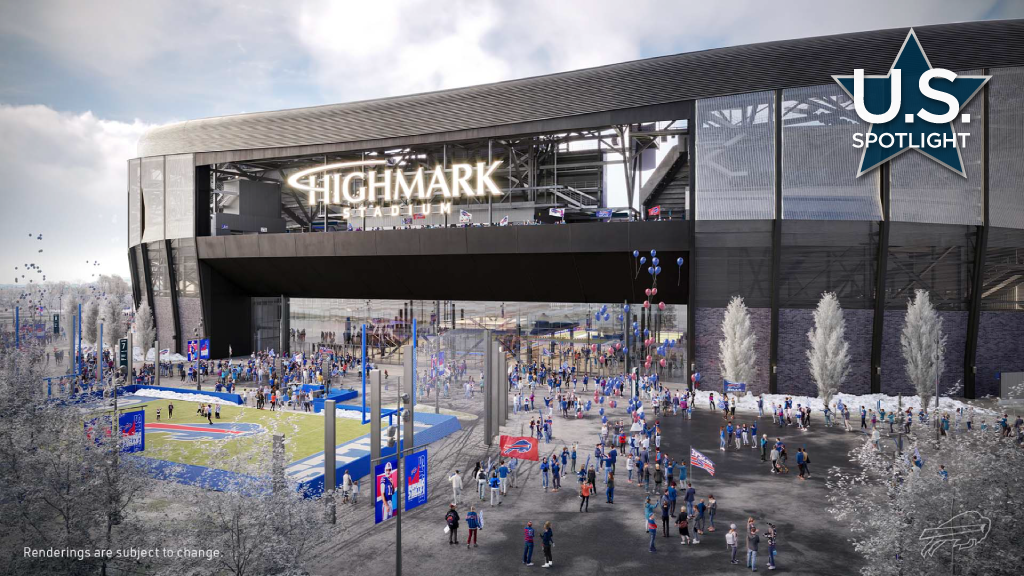
As winter winds sweep across Orchard Park, N.Y., a suburb southeast of Buffalo, a hulking new silhouette has risen along Abbott Road.
The metallic, brick-accented colossus signals the next chapter of football in western New York. It is the new home of the NFL Buffalo Bills and it will .
The $2.2-billion, 60,000-seat stadium, located across the street from the team’s current home, is entering its final stages of construction and will be ready in time for the 2026 football season.
The venue will blend cutting-edge engineering with the region’s blue-collar identity.
While some NFL franchises have pursued facilities that have embraced retractable roofs and climate-controlled domes so they could host year-round events, Buffalo’s ownership chose a different path.
The new stadium will remain open-air, a deliberate nod to the identity of the franchise and the elements that have long defined football in the region. Owners determined that a roof would add substantial cost without delivering proportional returns. So, they focused on enhancing the core football experience.
However, the fact the stadium is open-air does not mean that fans are unprotected from the biting winds and extremely cold winter temperatures. A sweeping 360-degree steel canopy will cover approximately 60 per cent of the seats, shielding fans from lake-effect snow.
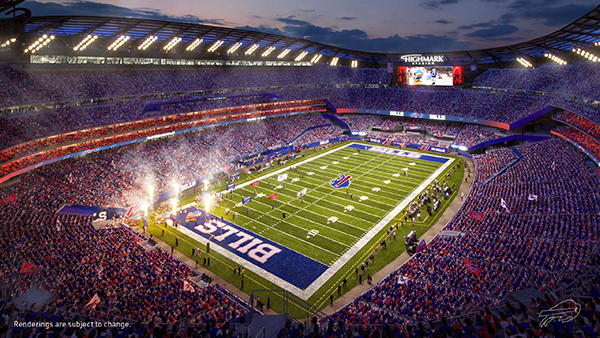
The canopy also houses the league’s largest snow-melt system. Embedded hydronic piping circulates hot water through the structure when sensors detect snowfall and temperature drops. Snow is melted as it lands, while radiant heat is directed downward toward the seating bowl.
But the canopy does more than block precipitation.
Angled inward, it is engineered to trap and reverberate crowd noise, intensifying the stadium’s acoustics and creating what team officials hope will be one of the loudest home-field advantages in the NFL.
The heating strategy extends beyond the canopy. Systems are embedded within sections of the precast concrete seating and beneath the natural grass playing field. The Bills opted for heated natural grass rather than artificial turf, aligning with growing league-wide discussions about surface safety and player preference.
Western New York’s biting winds posed another challenge. To address it, designers incorporated 4,400 perforated steel panels across the exterior façade.
As wind hits the perforations, it is diffused and slowed, disrupting wind flow before gusts can swirl into the seating bowl. The system will significantly reduce the blustery crosscurrents that have historically influenced games in Orchard Park.
The façade’s iron-spot brick base grounds the structure in Buffalo’s industrial esthetic, drawing inspiration from local landmarks such as Kleinhans Music Hall and other historic masonry buildings.
At 1.7 million square feet, the new facility will be significantly larger in footprint than its predecessor, although seating capacity will drop from 71,000. The reduction reflects a league-wide trend toward premium experiences and improved sightlines rather than maximizing upper-deck volume.
The upper seating deck will sit closer to the field than in any other NFL venue, bringing fans nearer to the action. Designers describe the building as “football-first,� with steep seating bowls and minimal visual distractions.
Seven major parking lots will surround the complex, preserving the tailgating culture that has become a hallmark of Bills game days.
The stadium will feature 360-degree concourses, heated circulation areas, frictionless food and beverage marketplaces as well as advanced audiovisual systems designed to set a new standard for open-air venues.
Premium amenities are concentrated along the east and west sidelines rather than forming a continuous ring.
Climate-controlled indoor suites will line the west side, while expansive club spaces will anchor the east. The 73,000-square-foot East Club is expected to be the largest unified club space in the NFL when the building opens.
Three “shell spaces,� totaling more than 45,000 square feet, have been constructed but left unfinished. Team executives plan to evaluate potential uses for those areas after the stadium’s first season, allowing flexibility for future premium or operational needs.
°µÍø½ûÇøion on the new stadium officially began with a groundbreaking on June 5, 2023. Excavation gave way to concrete pours and steel erection through 2024. The final steel beam was set in April 2025 in a topping-out ceremony attended by team ownership and league officials.
°µÍø½ûÇøion is now more than 85 per cent complete.
The venture is a public-private partnership. Public funding accounts for a significant portion of the cost, with contributions from both state and county governments under a lease agreement designed to keep the Bills in western New York for decades.
The project has not been without incident.
In December 2025, a minor construction fire caused by welding sparks was quickly extinguished without injuries or structural damage.
In February, graffiti discovered in secure interior areas led to a temporary work stoppage. Authorities identified several construction workers as suspects, and security measures at the site were heightened, including additional surveillance cameras and controlled-access monitoring.
Despite those setbacks, the stadium remains on schedule for a summer opening.
Recent Comments
comments for this post are closed