


There are nearly 5,000 across North America, but the number is growing rapidly. The U.S. alone has close to 400 currently in development, while Canada has dozens of its own in the planning stage.
However, the data centres being proposed today dwarf those of the past in size and capital cost.
The Canada data centre market is projected to by 2030 to U$22.24 billion, resulting in a major boom for the country’s construction industry. Globally, a McKinsey forecasts $6.7 trillion of capital expenditures associated with data centres and supporting infrastructure around the world over the next five years.
The rapid growth of AI is putting pressure to build these new facilities quickly.
“Things are not slowing down,� Roksana Taghizadeh, associate principal with Dallas-based structural engineering firm AG&E, told the 2024 National Institute of Building Sciences Building Innovation Conference. “There is huge demand for us to churn these out as quickly as possible to meet expedited construction schedules.�
The current timeline of nine to 12 months to complete a new facility is no longer acceptable, Charles-Antoine Beyney, CEO of data centre developer DataOne, told CRN.
Describing the outlook for his company’s new centre in Vineland, N.J, “We are talking about not even six months. Like at the end, we are targeting not even four months to build this turnkey data centre.�
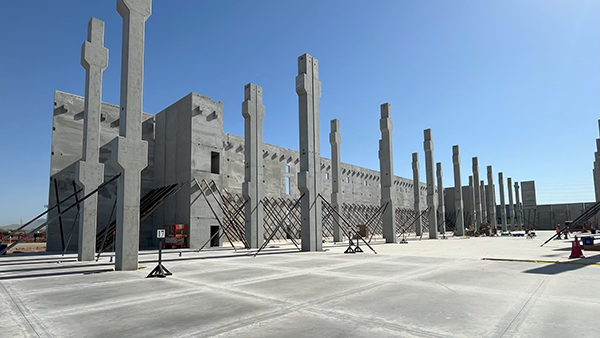
To meet such short construction schedules, developers are increasingly turning to precast panel componentry, fabricated offsite and supplied in modular fashion for onsite assembly.
Whether it is for walls, floors or roof panels in a total precast structure, or as an enclosure system, precast concrete is a desirable material choice for these buildings for a variety of reasons.
Data centres are not typically architectural marvels in themselves and instead tend to be sprawling, rectangular and highly-engineered low rise structures. Yet they present structural challenges the leading precast manufacturers are adapting to meet.
Due to the increased size and clear span requirements of the new data centres and their floor-to-floor heights of over nine metres, suspended loads have reportedly doubled exponentially while roof live loads have tripled in the years 2010 to 2024.
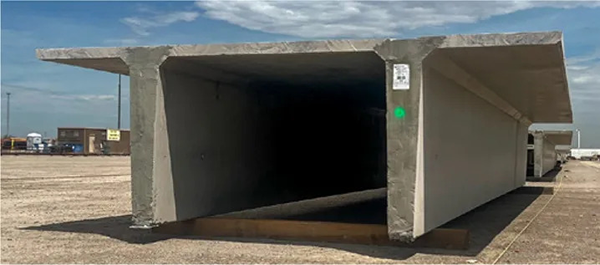
In response, manufacturers have adopted deep-stem double-tees to accommodate that approach 400 lb/ft2 on floors and 350 lb/ft2 on roofs. Sections can measure four metres wide and 12 metres deep. Precast concrete panels spanning over 18 metres are possible, with carbon fibre grids available as an option for additional strength and durability.
The massive amount of electronics inside a data centre requires sophisticated HVAC systems for temperature control.
Insulated precast concrete wall panels can be delivered with all the elements of a complete wall system, with finished surfaces and with built-in air and vapour barriers to create a temperature-controlled interior space. Reduced peak heating and cooling loads are possible given that R-values of R-20 or more are achievable, depending on insulation thickness and due to concrete’s thermal mass characteristics that react slowly to changes in outside temperature.
Insulation type can vary depending on the R-value being sought and budget allowances. Costs go up with increased R-values. Expanded/Molded Polystyrene (EPS) with its R-value of 4.0/inch is at the low cost end, while Extruded Polystyrene (XPS) offers R-5.0/inch and Polyisocyanurate delivers up to R-6.5/inch.
Structural resiliency is also important. Precast concrete offers unparalleled resistance to fires, natural disasters caused by extreme heat or cold, rain, wind and earthquakes, as well as to insects and mold. This lowers both maintenance and insurance costs.
While most data centres are located in outlying regions where land is less expensive, there is an argument to also build them on smaller infill sites closer to urban areas and closer to existing power grids and water supplies. This gives operators some assurance that their centres will have a streamlined network system for end-to-end minimal latency issues, Tom Widawsky, principal of HDR, a New York City-based multi-disciplined engineering consultancy, Architectural Products.Â
In these locations, the designs are becoming more compact and multi-storey. Precast, with the help of attractive façades, is again seen as a go-to project solution due to the speed of assembly that minimizes disruption to adjacent properties.
Given the complex challenges presented by the numerous architectural, electrical and mechanical requirements for today’s data centres, modular precast concrete construction is seen as a welcome solution.
John Bleasby is a freelance writer. Send comments and Inside Innovation column ideas to editor@dailycommercialnews.com.


Recent Comments
comments for this post are closed