

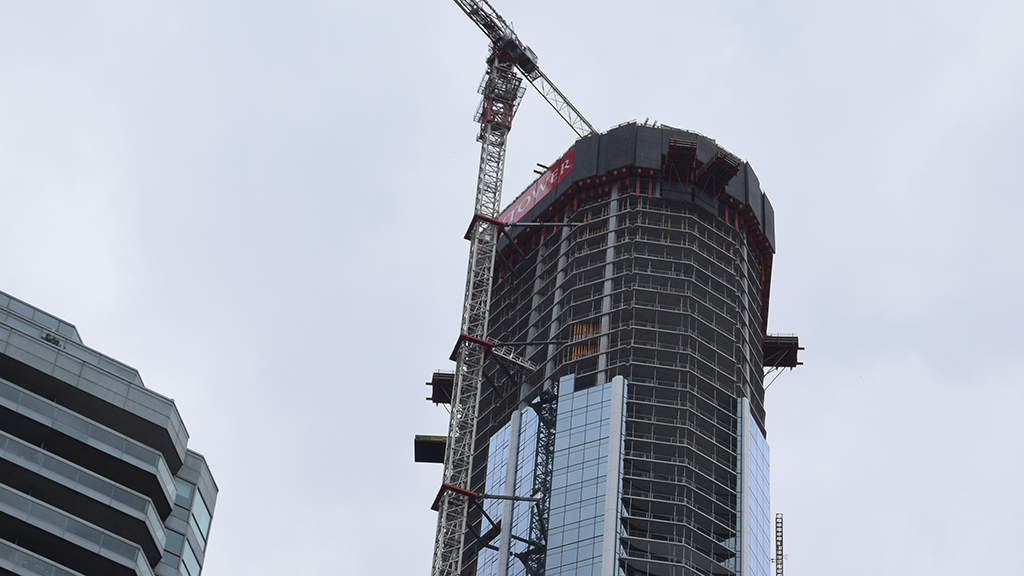
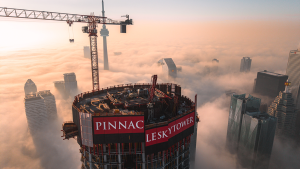
Rising amid a cluster of new downtown towers, Toronto’s 106-storey at One Yonge Street stands alone — not just as the tallest among them, but as a striking counterpoint to the iconic CN Tower.
A development from Vancouver-based Pinnacle International with design by Hariri Pontarini Architects, construction of the residential tower has reached 91 floors and completion is targeted for next year.
Hariri Pontarini Architects co-founder David Pontarini and Pinnacle vice-president offered insights into the evolution of the project – the City of Toronto has granted permission for a higher iteration several times, even as the tower was already under construction – during a recent presentation at the Council on Tall Buildings and Urban Habitat (CTBUH) International Conference held in the city.
The speakers displayed images of the CN Tower and the SkyTower, 1,200 metres apart, dominating the Toronto skyline. Pontarini said the juxtaposition symbolizes the transformation in Toronto’s downtown from a central business district when the CN Tower was built 50 years ago to a complete city centre, a “24/7 fully activated mixed-use, residential, office, commercial, retail city.�
The main observation deck of the CN Tower is 346 metres high while the SkyTower will top out at approximately 350 metres.
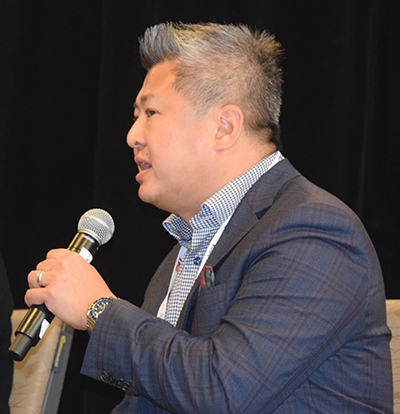
Kwok said the CEO of Pinnacle, Michael De Cotiis, refers to the SkyTower as a work of public art that “everyone the city will see and partner up with the CN Tower.�
The SkyTower is the second phase of three residential towers on the north parcel of land at 1 and 7 Yonge; the 65-storey Prestige, which includes a 50,000-square-foot recreation centre, was completed in 2022, while the third phase is currently approved for 95 storeys.
The tower features a 250-room hotel on the first 10 floors. The total number of residences in the three towers is projected at 2,500 units; the SkyTower itself will contain 800 units.
New south lands proposal
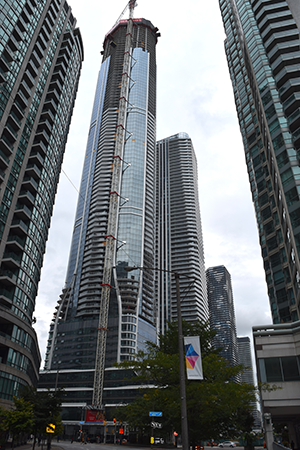
The south parcel was previously approved for two office towers and redevelopment of the former Toronto Star building. On Oct. 15, Pinnacle submitted a new proposal for two residential towers with heights of 80 storeys and 85 storeys. The proposed development would include 2,406 dwelling units, 237 hotel suites and other uses.
“Part of the reason I think CTBUH is here is because of the phenomenal growth that the city of Toronto has seen, and I think there’s interest around the world in seeing how it’s been dealt with,â€� said Pontarini. “Toronto is appearing with cities like New York, Dubai, Shenzhen, and it really is a mature city in terms of development, in terms of growth, and it continues to add to the 100-metre-tall buildings.â€�
Another panellist, City of Toronto community planning director , outlined how the city created a Central Waterfront Secondary Plan in 2003 and then a Lower Yonge Precinct Plan in 2016 that encouraged super tall residential buildings amid new parkland and places for people to “live, work and visit.�
Pinnacle participated in discussions on the precinct plan as well as undertaking significant work on its own, Bowman said, over the years collaborating with the designers and city staff to gain an understanding of how the state of the art in the creation of supertall buildings was developing.
Part of that process, Bowman said, was regularly attending CTBUH conferences to discover newly evolving best practices.
“We’re always bringing our curiosity to the idea, ‘OK, well, we hadn’t thought of that. Tell us more,’â€� she said. “How does it reflect the policy intent, and how do you see this extending into the area context in a positive way.â€�
Pontarini and Kwok said De Cotiis continually pushes to exceed the height restraints that seem to bind other developers.
“For us, it was a bit of a learning curve, kind of a leap of faith, could we really execute on this?� said Pontarini, “as the design kept changing and morphing from 95 to 100 to 105 to 106.�
The conference ran Oct. 6 to 9. At the end of day two, the council’s name was officially changed to the Council on Vertical Urbanism.
The developer declined to comment on the new proposal for the One Yonge south lands.



Recent Comments
comments for this post are closed