

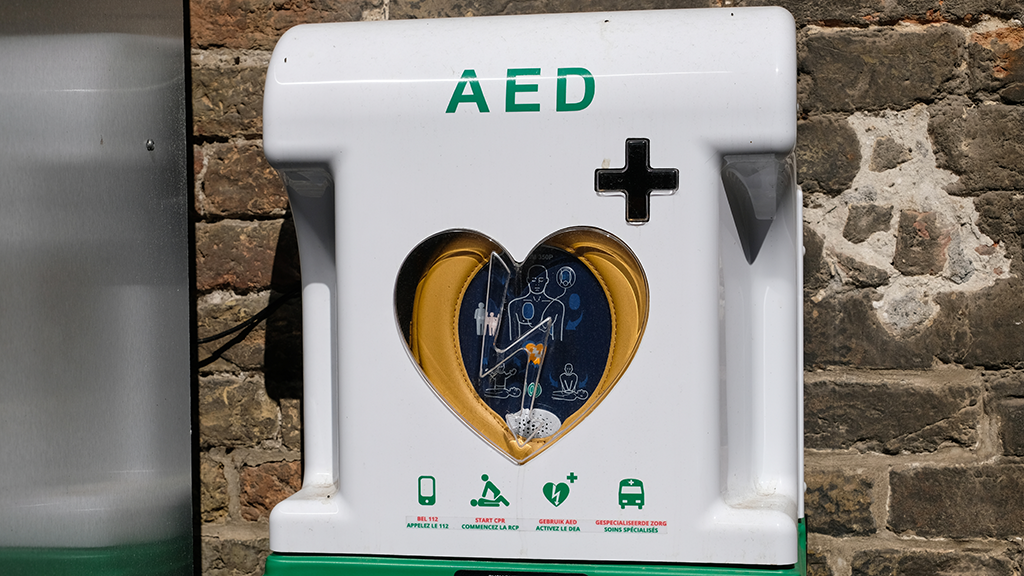
Having an automated external defibrillator (AED) on hand at a construction site could be the difference between life and death if an incident occurs.
That was the stark and explicit warning from medical and industry professionals who spoke at a webinar on the topic recently.
“When we look at construction work, all of its characteristics, the environment that it’s worked in, sometimes emergency services are not immediately accessible,â€� said Ontario Chief Prevention Officer Dr. Joel Moody. “Having an automatic external defibrillator can save lives and it does.
“We know about hard hats, we know about your harnesses, we know about your safety boots, but let’s also know about an AED.â€�
The webinar, titled AEDs (Mikeys) on °µÍø½ûÇøion Sites, was hosted by the Residential °µÍø½ûÇøion Council of Ontario and sponsored by Sherrard Kuzz LLP and The Mikey Network.

The aim of the network is to ensure construction sites have defibrillators. The AEDs are dubbed Mikeys after Mike Salem, a partner in Heathwood Homes and Herity, who died of cardiac arrest in 2002.
As of Jan. 1, AEDs will be required on Ontario construction sites when projects last three months or longer and employ 20 or more workers. The province is the first jurisdiction in North America to make AEDs mandatory. A WSIB program will help offset the cost for eligible constructors.
As a physician, Moody said he’s been in situations where a patient is in cardiac arrest and the only way to save the individual is to get the heart started again quickly, which is what a portable AED does. Specifically, the device analyzes a persons’ heart rhythm and delivers an electrical shock, if necessary, to restore a normal rhythm during a sudden cardiac arrest.
“When a cardiac arrest happens or arrhythmia, every second counts,â€� said Moody. “Without that immediate intervention, survival rates drop by more than 10 per cent every minute. We know that CPR isn’t enough sometimes. And it’s only that AED that can restore that normal heart rhythm.â€�
By law, constructors and employers are responsible for preventing incidents and fatalities so having an AED onsite and people who are trained is part of what they should be doing, said Moody.
Eva Naumovski, co-chair of The Mikey Network and director of sales and marketing at Herity, said it takes, on average, 10 minutes for an ambulance to respond in an emergency.
“That doesn’t sound like a long time, but for every minute your body isn’t pumping blood, you lose 10 per cent of your brain function. That means 100 per cent of your brain function is probably gone by the time the ambulance arrives. It’s really important to have that machine onsite.
“When you’re having a cardiac arrest, instead of your heart pumping, your heart literally starts to shake in your body and it quivers. The shock from this machine, from a Mikey, resets this pulse and this muscle to go back into this pumping motion and get that blood circulating again, and getting your body all the oxygen and all the blood flow that it requires.â€�
Chuck Resnick, president of The Mikey Network and executive vice-president and director of marketing at Koala Insulation Canada, told the webinar the AEDs should be located in areas that are accessible.
“Don’t place it in someone’s office or the construction office where in an emergency somebody has to go and rummage through and find it. Place it where there’s plenty of traffic in the office, in an open area where the cabinet can be affixed to the wall in plain sight.â€�
Resnick recommends the device be kept indoors as extreme cold could cause it to malfunction. He also says training several staff how to use an AED is vital.
“People get ill, people go on vacation, but I think you owe it to your staff to the degree to which you’re able to get everybody involved from the standpoint of understanding the benefits of having it there, how to use it, and effectively you have to market it to your people so that they know what it’s all about. The more you communicate, the better off everybody’s going to be.â€�
Emergency Preparedness and Response Minister Jill Dunlop told the audience in a taped message that emergency preparedness is everyone’s responsibility as using an AED within three to five minutes of an incident can double or even triple the survival rate of an individual.
“In the face of economic uncertainty, our government will do whatever it takes to protect our province’s greatest competitive advantage, our highly skilled, worldclass workforce.â€�

Recent Comments
comments for this post are closed