

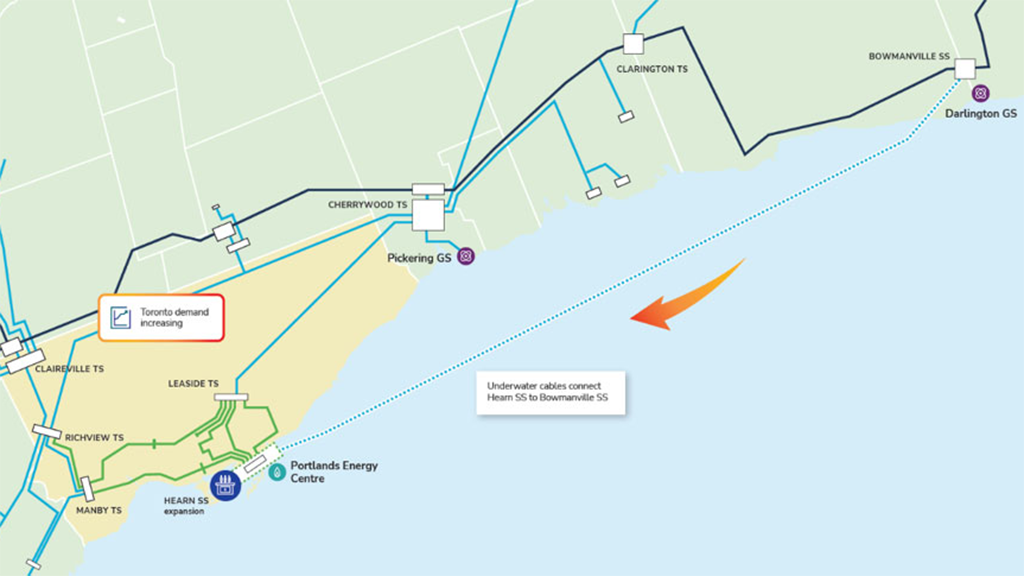
TORONTO – The Ontario government is taking a deep dive,ÌýapprovingÌýthe Independent Electricity System Operator’s (IESO) recommendation to build a new underwater electricity transmission line from near the Darlington Nuclear Generating StationÌýin Bowmanville, Ont.Ìýto the downtown core and easternÌýportionÌýof Toronto.
TheÌýfirst-of-its-kind high-voltage underwater transmission line in OntarioÌýis being constructedÌýin order toÌýkeepÌýup with growth as electricity demand in Toronto is expected to double by 2050, a release reads.
Currently, the City of Toronto is supplied by two transmission lines, one from the west at Manby Transmission Station (TS) and one from the east at Leaside TS. These pathways will begin to reach their capacity in the 2030s.ÌýTheÌýthird transmission lineÌýwillÌýdeliverÌý900 MW ofÌýadditionalÌýpower, equivalent to all the power generated from three small modular reactors, or power for 900,000 new homes.
With news of the approval, theÌýgovernment is proposing the IESOÌýlaunchÌýa competitive procurement process to select a transmitter, which will be informed by a consultation onÌýthe procurementÌýdesign.
The provinceÌýstatesÌýthe reason for an underwater line is because itÌýis less vulnerable to extreme weather events such as flooding or ice storms.Ìý
“The underwater cable will also deliver more capacity than any other option and meet the system needs beyond 2044, reducing the need for additional, costly upgrades and expansions,â€� the release notes. “The third line will also alleviate strain on the bulk power system by avoiding bulk system reinforcements elsewhere in the GTA which could result in an estimated preliminary savings of $100ÌýtoÌý$300 million.â€�Ìý
The development,ÌýconstructionÌýand commissioning could take between seven to 10 years to complete.
The IESO’s recommendation follows analysis of multiple options, prioritizing routes that minimize land-useÌýimpactsÌýbyÌýleveragingÌýexisting corridors, underground infrastructure and pathways, the release adds. The proposal is detailed in the .Ìý
The province notesÌýunderwater transmission lines have been used in Newfoundland and Labrador, NovaÌýScotiaÌýand Prince Edward Island.Ìý






Recent Comments
comments for this post are closed